At a Glance: What Happened?
For many girls, the transition from 5th to 6th grade is when math stops feeling fun and starts feeling intimidating. Math anxiety creeps in, while confidence often drops (Boaler, 2016; Dowker, Sakar, & Looi, 2016). However, practicing hands-on activities that build visual skills directly helps girls feel more confident in math (Maloney et al. 2012; Ramirez et al. 2012).
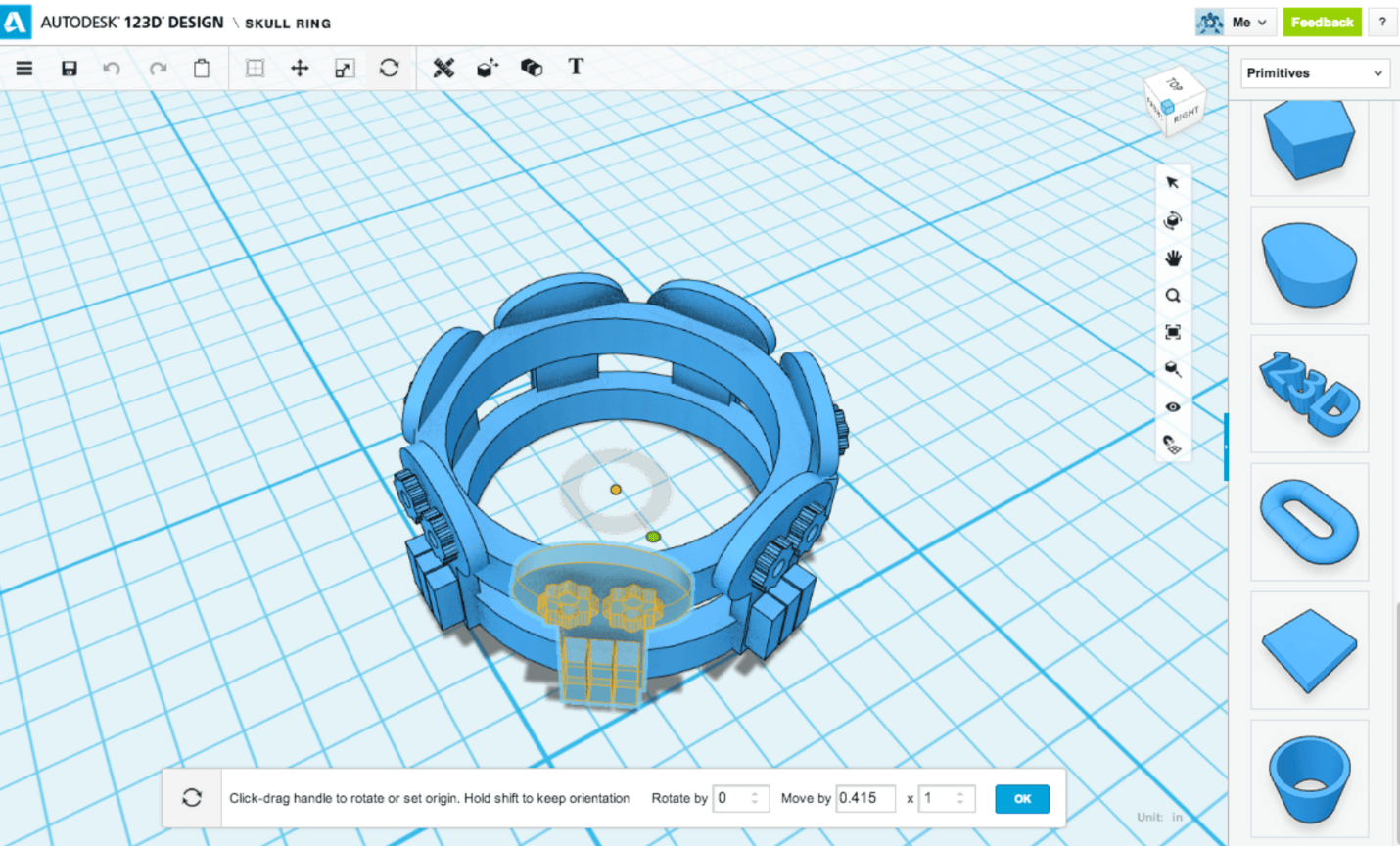
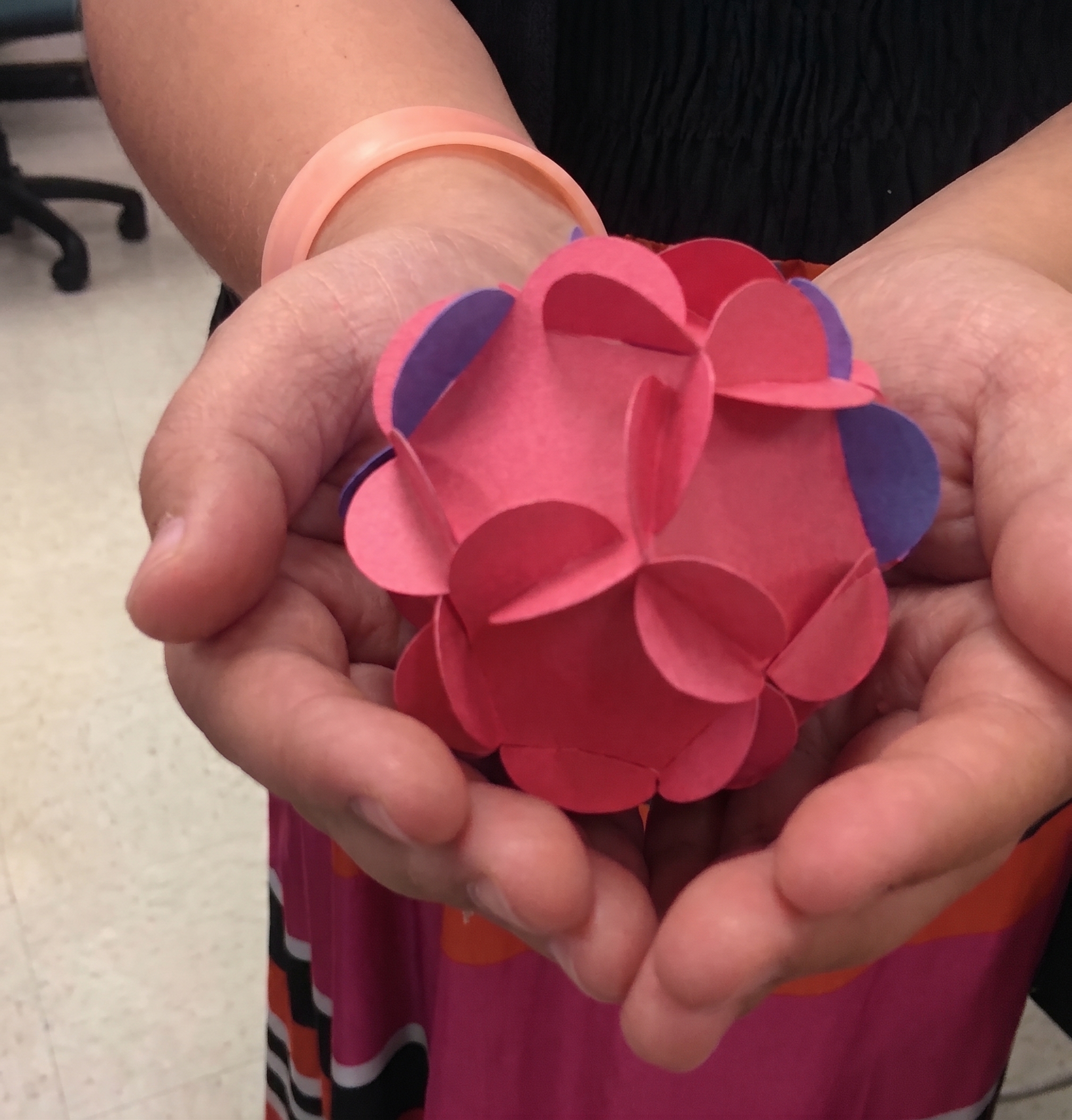
To see if a design-focused approach could positively impact girls’ mathematical confidence, my team developed and hosted an innovative 10-day summer program called the iAM (Integrating Art and Mathematics) Camp that invited 20 rising 6th-grade girls (ages 10-11) to learn math through creative hands-on design activities. Instead of completing drills or worksheets during the 40-hour, 10 day/two-week program, the girls used real-world tools including 3D printers, CAD modeling software (see Figure 1), and digital paper/vinyl cutters to create tangible products inspired by their everyday lives, such as pop-up cards, custom jewelry, interlocking sculptures (see Figure 2), packaging boxes, and working musical instruments.
The goal was simple: use mixed methods research to show that when girls use math as a creative tool to build things they care about, their spatial reasoning skyrockets, their math anxiety drops, and their confidence grows.
The Big Takeaways
- Spatial skills soared from 36% to over 90%: On a standard 12-question 3D mental rotation test (the PSVT:R), the girls’ average score jumped +54 percentage points.
- Math anxiety dropped across the board: On a recognized middle school math self-efficacy survey, students reported noticeably less stress (26% reduction), less mental exhaustion (42% reduction), and fewer moments where their “mind went completely blank” (45% reduction).
- Praise and encouragement made the biggest splash: The single largest jump across the entire survey was students agreeing that their teachers told them they were genuinely good at math (surging from 1.00 to 2.45 on a scale up to 3.00).
What Did the Girls Actually Do for 10 Days?
The camp met Monday through Friday for 4 hours each morning. Each day introduced a new design challenge where math wasn’t an abstract formula. Math was actually the secret ingredient needed to make their designs hold together, fold properly, or fit their fingers.
| Days | Projects & Activities | Core Math Concepts |
|---|---|---|
| Days 1–3: Flat Designs & Clever Folds | Designed custom camp t-shirts and 3D pop-up cards.Built packaging boxes from flat cardstock using digital cutting machines. | Symmetry, coordinate grids, and 2D folding patterns (nets). |
| Days 4–6: 3D Puzzles & Geometric Art | Created intricate kirigami and interlocking 3D puzzles.Assembled mathematical polyhedral sculptures from flat interlocking shapes. | Tessellations, geometric angles, and multi-piece assemblies. |
| Days 7–9: Digital 3D Modeling & 3D Printing | Learned Tinkercad computer-aided design (CAD) software.Designed and 3D-printed custom rings, pendants, and scale model furniture.Prototyped and 3D-printed functioning acoustic musical instruments. | Precise millimeter measurements, diameters, ratios, and acoustics. |
| Day 10: Makerspace Showcase | Final open-choice building day followed by a family and friends exhibition. | Applied mathematical concepts and project presentation. |
The Results: Breaking Down the Numbers
1. Spatial Thinking: The 3D Mental Rotation Test (PSVT:R)
Spatial visualization is the ability to picture a 3D object in your mind and imagine turning it around in space. It is a highly trainable skill and is one of the strongest early indicators of whether a student will thrive in STEM subjects like engineering, physics, chemistry, and higher-level geometry (Uttal et al. 2013; Wai, Lubinski, & Benbow, 2009).
In this PSVT:R test (Yoon, 2011), students were shown an object rotated at an angle and had to figure out what a second object would look like if rotated the exact same way.
- Pre-Camp Average: 4.35 out of 12 (only 36.3% accuracy).
- Post-Camp Average: 10.85 out of 12 (an impressive 90.4% accuracy).
- Average Gain: +6.50 points (+54.2 percentage points).
- Statistical Power: A paired statistical test yielded t=15.25 and an effect size (Cohen’s d) of 3.41. In educational research, an effect size of 0.8 is considered “large.” A score of 3.41 is extraordinarily rare.
Student-by-Student Score Breakdown
| Student | Before Camp Score (/12) | Before Camp (%) | After Camp Score (/12) | After Camp (%) | Score Improvement | Percentage Point Jump |
| Student 1 | 7 | 58.3% | 12 | 100.0% | +5 | +41.7% |
| Student 2 | 3 | 25.0% | 10 | 83.3% | +7 | +58.3% |
| Student 3 | 1 | 8.3% | 11 | 91.7% | +10 | +83.3% |
| Student 4 | 8 | 66.7% | 12 | 100.0% | +4 | +33.3% |
| Student 5 | 2 | 16.7% | 10 | 83.3% | +8 | +66.7% |
| Student 6 | 3 | 25.0% | 12 | 100.0% | +9 | +75.0% |
| Student 7 | 6 | 50.0% | 12 | 100.0% | +6 | +50.0% |
| Student 8 | 7 | 58.3% | 11 | 91.7% | +4 | +33.3% |
| Student 9 | 6 | 50.0% | 12 | 100.0% | +6 | +50.0% |
| Student 10 | 2 | 16.7% | 12 | 100.0% | +10 | +83.3% |
| Student 11 | 4 | 33.3% | 11 | 91.7% | +7 | +58.3% |
| Student 12 | 5 | 41.7% | 10 | 83.3% | +5 | +41.7% |
| Student 13 | 4 | 33.3% | 8 | 66.7% | +4 | +33.3% |
| Student 14 | 5 | 41.7% | 12 | 100.0% | +7 | +58.3% |
| Student 15 | 8 | 66.7% | 12 | 100.0% | +4 | +33.3% |
| Student 16 | 5 | 41.7% | 12 | 100.0% | +7 | +58.3% |
| Student 17 | 2 | 16.7% | 7 | 58.3% | +5 | +41.7% |
| Student 18 | 2 | 16.7% | 9 | 75.0% | +7 | +58.3% |
| Student 19 | 4 | 33.3% | 11 | 91.7% | +7 | +58.3% |
| Student 20 | 3 | 25.0% | 11 | 91.7% | +8 | +66.7% |
| Group Average | 4.35 | 36.3% | 10.85 | 90.4% | +6.50 | +54.2% |
In high school and college engineering, 70% is generally viewed as the passing benchmark for spatial readiness. At the start of camp, zero out of 20 girls reached that benchmark. By Day 10 of camp, 19 out of 20 girls (95%) crossed it, and nearly half the class (9 girls) got a flawless 100%!
2. Mathematics Self-Efficacy: How Did Their Feelings About Math Change?
The camp used the well-regarded mathematics self-efficacy survey (Usher and Pajares, 2009), which asks students 24 questions across four key areas of math confidence. The ratings range on a simple scale from -3 (Really False / Strongly Disagree) to +3 (Really True / Strongly Agree), where 0 is neutral.
| Confidence Area | Before | After | Change |
|---|---|---|---|
| Social Encouragement (Praise from teachers/peers) | +0.68 | +0.95 | +0.27 Gain |
| Math Stress & Anxiety (Lower = less stress) | -0.87 | -1.13 | -0.26 Reduction |
| Learning by Watching Others (Teacher & peer modeling) | +1.44 | +1.39 | -0.05 |
| Past Math Success (Grades & assignment memory) | +1.28 | +1.18 | -0.10 |
Area 1: Calming Math Anxiety (Physiological & Affective States)
In this category, every question measured stress, mental fatigue, or panic. Because these questions are negative, a lower score is a big win. It means students disagree even more strongly with feeling nervous or overwhelmed.
Overall anxiety dropped by -0.26 points (moving from -0.87 to -1.13). Every single item in this category improved:
- “My mind goes blank and I can’t think clearly when doing math” (Item 22): Dropped by -0.45 points (from -1.30 to -1.75). Mental “freezing” was significantly reduced.
- “Doing math work takes all of my energy” (Item 20): Dropped by -0.42 points (from -0.58 to -1.00). Working with math stopped feeling so draining.
- “I start to feel stressed as soon as I begin my math work” (Item 21): Dropped by -0.30 points (from -0.25 to -0.55). That initial wave of dread when seeing a problem quieted down.
- “I get depressed when I think about learning math” (Item 23): Dropped by -0.20 points (from -0.80 to -1.00).
- “My whole body becomes tense when I do math” (Item 24): Moved from -1.90 to -2.00, confirming that physical panic remained practically nonexistent.
- “Just being in math class makes me feel stressed” (Item 19): Improved slightly by -0.05 points (from -0.40 to -0.45).
Area 2: The Power of Words (Social Persuasions)
This area had the biggest positive boost in the entire survey, gaining +0.27 points overall:
- Teacher Validation (Item 13): “My math teachers have told me that I am good at learning math” went through the roof, increasing by +1.45 points (from 1.00 up to 2.45). When teachers connected the girls’ artistic designs directly to mathematical skill, the girls genuinely believed it.
- Peer Praise (Item 17): “Other students have told me that I’m good at learning math” rose by +0.30 points (from 1.20 to 1.50).
- Classmate Teamwork (Item 18): “My classmates like to work with me in math” increased by +0.13 points (from 0.55 to 0.68).
Why Did Everyday Assignment Confidence Slightly Dip?
Interestingly, the Mastery Experience subscale shifted down slightly by -0.10 points, and Vicarious Experiences shifted down by -0.05 points. Why?
- Before camp, the girls based their idea of being “good at math” on easy 5th-grade worksheets (Item 5: “I do well on math assignments” was initially rated an overly optimistic 2.30).
- At camp, they encountered real-world engineering problems: measuring tight millimeter clearances, calculating 3D scaling, and debugging 3D prints. They realized math is much bigger than simple memorization!
- Noticeably, their confidence on tough problems actually went up: Item 6 (“I do well on even the most difficult math assignments”) increased by +0.45 points (from 0.25 to 0.70). They learned what real challenge felt like and discovered they could handle it.
What the Girls Said: Voices from Camp
The exit interviews revealed a profound shift in mindset:
- Mistakes Became Fixes, Not Failures: In typical math classrooms, a wrong answer gets a red ‘X’. In the camp’s makerspace, an error meant a cardboard slot was too tight or a ring slipped off a finger. The girls didn’t see that as failing; they saw it as a design tweak. As one student shared, “When my ring printed too small, I didn’t think I was bad at math. I just needed to adjust the inner diameter by 2 millimeters in Tinkercad and print again!”
- Friends Helping Friends: Instead of hiding their papers or competing for test scores, girls gathered around computer monitors to help each other figure out why a 3D prism wasn’t folding right or how to center a shape.
Four Practical Recommendations for Teachers and Parents
Ten days of hands-on design didn’t just teach these 20 girls how to make art. It gave them the spatial tools, the emotional calm, and the confidence to see themselves as capable mathematicians. So how can regular schools and after-school programs use these lessons to help more kids love math?
- Connect Math Directly to Physical Making
- Stop keeping geometry on flat paper. Use paper folding, pop-up mechanisms, and simple 3D modeling programs (like Tinkercad) to teach shapes, perimeter, volume, and angles. When students physically assemble a shape, their spatial brain turns on.
- Call Art and Design by Its True Name: Mathematics
- Don’t let kids assume that making cool things is “just art” while math is only numbers on a test. Point out the math out loud: “Look at that rotational symmetry in your paper cut,” or “You just calculated scale and ratios to make that furniture fit!” Explicit praise bridges the gap between creativity and math self-belief.
- Adopt a “Design Draft” Mindset in the Math Classroom
- Much of math anxiety comes from the fear of being wrong on the first try. Introduce draft rounds for math problem-solving, just like in art or writing. When students know an initial mistake is just a first prototype, their stress drops and their minds don’t go blank.
- Reward Spatial Thinking, Not Just Speed
- While automaticity is an important mathematical skill, timed drills and speed tests frequently trigger math anxiety in young girls. Encourage sketching, diagrams, physical models, and collaborative problem-solving instead. Understanding how pieces fit together creates a much deeper, long-lasting math foundation than racing a stopwatch.
Summary Scorecard
| Area Tested | Pre-Camp | Post-Camp | Total Change | What This Means in Plain English |
| 3D Spatial Rotation Test | 36.3% | 90.4% | +54.2% jump | A huge leap into advanced spatial skills; 19 out of 20 girls hit engineering-ready benchmarks. |
| Math Anxiety & Tension | -0.87 | -1.13 | -0.26 reduction | Meaningfully less stress, less mental exhaustion, and much less “freezing up.” |
| Praise from Teachers | +1.00 | +2.45 | +1.45 surge | Girls felt recognized for their mathematical talent through their creative work. |
| Tackling Difficult Math | +0.25 | +0.70 | +0.45 gain | Girls grew more confident tackling challenging problems rather than just easy worksheets. |
References
Boaler, J. (2016). Mathematical mindsets: Unleashing students’ potential through creative math, inspiring messages and innovative teaching. Jossey-Bass.
Dowker, A., Sarkar, A., & Looi, C. Y. (2016). Mathematics anxiety: What have we learned in 60 years? Frontiers in Psychology, 7, Article 508. doi: 10.3389/fpsyg.2016.00508
Maloney, E. A., Waechter, S., Risko, E. F., & Fugelsang, J. A. (2012). Reducing the sex difference in math anxiety: The role of spatial processing ability. Learning and Individual Differences, 22(3), 380–384.
Ramirez, G., Gunderson, E. A., Levine, S. C., & Beilock, S. L. (2012). Spatial anxiety relates to spatial abilities as a function of working memory in children. Quarterly Journal of Experimental Psychology, 65(3), 474–487.
Usher, E. L., & Pajares, F. (2009). Sources of self-efficacy in mathematics: A validation study. Contemporary Educational Psychology, 34(1), 89–101. https://doi.org/10.1016/j.cedpsych.2008.09.002
Uttal, D. H., Meadow, N. G., Tipton, E., Hand, L. L., Alden, A. R., Warren, C., & Newcombe, N. S. (2013). The malleability of spatial skills: A meta-analysis of training studies. Psychological Bulletin, 139(2), 352–402. https://psycnet.apa.org/record/2012-14754-001
Wai, J., Lubinski, D., & Benbow, C. P. (2009). Spatial ability for STEM domains: Aligning over 50 years of cumulative psychological knowledge solidifies its importance. Journal of Educational Psychology, 101(4), 817–835. https://psycnet.apa.org/record/2009-19591-005
Yoon, S. Y. (2011). Psychometric properties of the Revised Purdue Spatial Visualization Tests… (Doctoral dissertation, Purdue University). ProQuest Dissertations & Theses; Purdue University. https://docs.lib.purdue.edu/dissertations/AAI3480934
